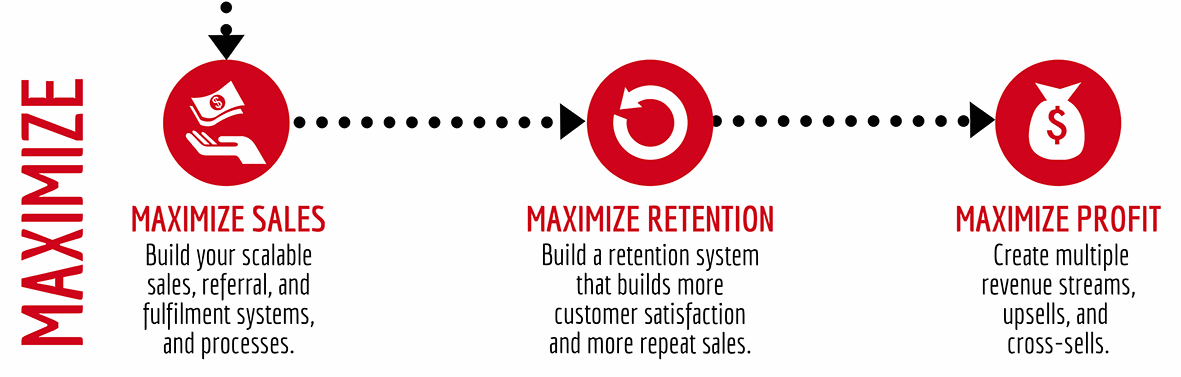
Scale sales, retention, and revenue streams so the business compounds. Three modules. Each one ends with the instrument question that keeps it honest.
/02
3.1
Maximize and Scale Your Sales Process
A sales process that lives in the founder’s head has a ceiling: the founder’s hours. Scaling starts with writing down what actually happens from first conversation to signed deal — the stages, the questions, the criteria for advancing or disqualifying — so the process can be measured, handed over, and improved as a system rather than a talent.
Once it’s written, instrument it. Conversion by stage, cycle length, average deal size, win/loss reasons. Most businesses discover the leak is not where they assumed: they don’t have a closing problem, they have a qualification problem, and they’re spending expensive hours on deals that were never real.
Then scale the constraint, in order. More leads into a broken stage buys more losses. Fix the weakest stage first, confirm the reading improves, then increase volume. The businesses that grow calmly are the ones that treat sales like an engineering problem — the ones that don’t are forever hiring closers to compensate for an unmeasured pipeline.
Instrument question
Which stage of your pipeline has the lowest measured conversion — and what did you change there last quarter?
3.2
Maximize Value From Your Existing Customers — Maximize Retention
Retention is the most under-instrumented number in small business. Owners can tell you last month’s new revenue to the dollar and cannot tell you how many customers quietly stopped buying. Yet the arithmetic is brutal: a customer kept is revenue with zero acquisition cost, and a customer lost must be replaced before you grow at all.
Start with the ledger. Define what "active" means for your business, list every customer, and mark each one. The churn you find in that exercise is usually the first honest reading the business has ever had. From there, the causes sort quickly: delivery gaps, silence between transactions, or a customer who was never the right fit in the first place.
Then systematize the relationship the way you systematized the sale: scheduled check-ins, a documented delivery standard, an explicit moment where you ask what else they need. Retention is not warmth; it is a cadence. Existing customers should be your cheapest growth channel — if they aren’t, the instrument is telling you something about delivery.
Instrument question
What percentage of last year’s customers are still active — and do you know why the others left?
3.3
Maximize Your Profit by Creating Multiple Revenue Streams
Multiple revenue streams are not diversification for its own sake — that path leads to three mediocre businesses instead of one good one. The version that compounds is adjacency: new streams built on the customers, delivery capability, and proof you already have, sold to a market that already trusts you.
Sequence by leverage. The first additional stream is usually the one your existing customers are already asking for, or the obvious next problem after the one you solve. It carries near-zero acquisition cost because the relationship exists. Only after that stream is instrumented and stable do you earn the right to open a third.
Judge each stream on its own ledger: its margin, its demand on founder time, its retention. A stream that adds revenue but consumes the hours that run the core business is a liability wearing a growth costume. The goal is a portfolio of streams that share one operating system — so each one you add makes the others cheaper to run, not harder.
Instrument question
If you listed every revenue stream with its own margin and founder-hours, which one would you close tomorrow?
/03
FROM THE ORIGINAL PROGRAM — THE BUSINESS MAXIMIZER FRAMEWORK, 44 PP.
Maximizing Sales, Referral, and Profits
The final section of the original nine-step program maximizes what the first two built: a high-converting sales process, increased customer retention, and profit grown through upselling, cross-selling, and cost discipline.
Maximize Sales builds the scalable sales, referral, and fulfilment systems that convert leads into customers. Maximize Retention builds the system that builds customer satisfaction and repeat sales — exceptional service, loyalty programs, referral marketing. Maximize Profit opens multiple revenue streams through upsells and cross-sells, optimizes pricing, and reduces costs. Retention and profit sit downstream of sales for a reason: you cannot retain a customer you never closed.
STEP 1 — MAXIMIZE SALESCreate a high-converting sales process designed to convert leads into customers.
STEP 2 — MAXIMIZE RETENTIONIncrease retention with exceptional customer service, a loyalty program, and referral marketing.
STEP 3 — MAXIMIZE PROFITMaximize profits through upselling and cross-selling, optimized pricing, and reduced costs.