Know your market and package what you sell so the right people choose you. Three modules. Each one ends with the instrument question that keeps it honest.
/02
1.1
Market Research
Most owners research their market once — at the beginning, when enthusiasm substitutes for evidence — and then run for years on what they believed at the time. Markets move. The customers who buy now, the reasons they buy, and the alternatives they compare you against are all measurable facts with a shelf life.
Do the unglamorous version. Interview the last ten people who bought and the last ten who didn’t. Ask what they were comparing, what nearly stopped them, and what they would have paid more for. Write the answers down verbatim; your paraphrase is where the bias lives.
Count before you conclude. One loud customer is an anecdote; five quiet ones saying the same thing is a signal. The deliverable of this module is not a feeling of clarity — it is a short written document: who buys, why, against which alternative, at what price sensitivity.
Instrument question
What evidence do you have — not belief — about who buys and why?
1.2
Package Your Product / Service
Packaging is not branding. It is the discipline of turning what you do into something a specific buyer can understand, compare, and say yes to without you in the room. If the offer needs you present to explain it, it is not packaged — it is improvised, and it will never scale past your calendar.
A package has fixed edges: a named outcome, a defined scope, a stated price or price logic, and terms a buyer can repeat to their partner or board in one sentence. Vagueness feels flexible. It is actually friction — every unclear edge becomes a negotiation, and every negotiation costs you margin and time.
Test the package against your research. The buyer from module 1.1 should recognize their own problem in your description and see the price as a ratio against the outcome, not a number in a vacuum. If they can’t, the package is describing you, not them.
Instrument question
Could a buyer repeat your offer — outcome, scope, price — accurately without you?
1.3
Test and Validate Your Package
Validation is the step owners skip because it delays the gratification of launching. It is also the step that separates a position from a guess. You do not validate with compliments, waitlists, or enthusiasm at dinner. You validate with transactions, or binding commitments that behave like transactions.
Run the smallest honest test: offer the package to a countable number of real prospects in your target market and record what happens. Conversion rate, objections, time-to-decision, discount pressure. The numbers are the instrument reading; everything else is commentary.
Then decide like an auditor, not a founder. If the package converts, document why and lock it. If it doesn’t, the failure is cheap information — change one variable at a time (buyer, outcome, price, terms) and retest. What you cannot do is skip to promotion and let marketing spend discover what a two-week test would have told you.
Instrument question
What is your measured conversion rate on the current package — and when did you last test it?
/03
FROM THE ORIGINAL PROGRAM — THE BUSINESS MAXIMIZER FRAMEWORK, 44 PP.
Creating a Market Leader Position
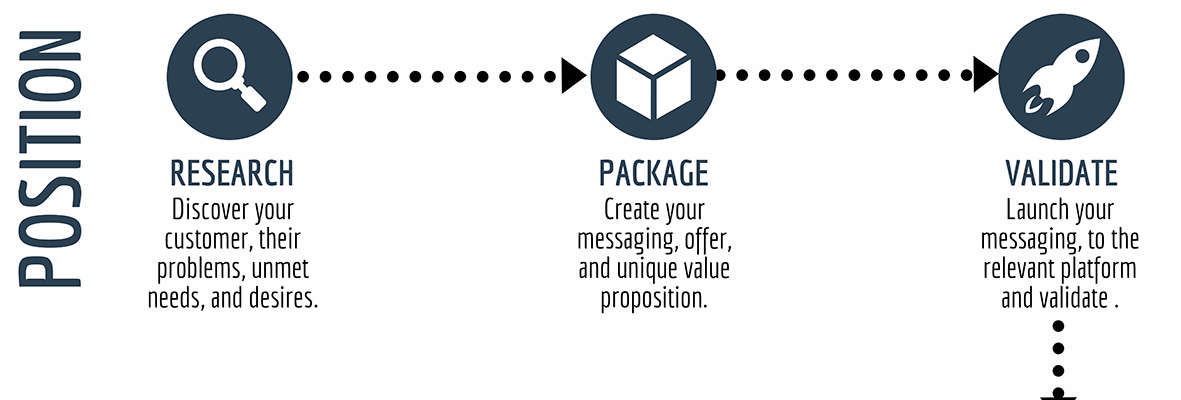
The original nine-step Business Maximizer Program opens with the Position section: research the market, package the product or service, and validate the unique value proposition. The three modules above are this section, written out as an operating standard.
The sequence is the discipline. Research discovers the customer — their problems, unmet needs, and desires. Packaging turns that discovery into messaging, an offer, and a unique value proposition the market can actually parse. Validation then launches the messaging to the relevant platform and lets the market vote — before any promotion spend.
STEP 1 — RESEARCHConduct market research to understand the needs, wants, and pain points of the target market.
STEP 2 — PACKAGINGPackage the products and services in a way that meets the needs and desires of the target market.
STEP 3 — VALIDATEValidate the unique value proposition and ensure it resonates with the target market.